Digital Resource 1: Calmsley Hill City Farm Website
Purpose: Supports both students and teachers with direct information about the Calmsley Hill City Farm for Learning Experience 1.
The Calmsley Hill City Farm website is a useful resource that provides a digital connection to the community resource that can be explored throughout the learning experience. Teachers can utilise the website prior or after the excursion to introduce students to the site and further encourage their learning of the animals, its environment and what the site has to offer. The website can also assist students revisit what they learnt and create connections between what they observed during the visit and how the farm operates. The source assists students and teachers in providing information that can support questioning, discussion and further investigation overall.
Digital Resource 2: Padlet
Purpose: Supports Learning Experience 2 by allowing students to share plans of their sustainable farm designs.
Padlet provides students with a digital platform to share their learning with their peers. After drawing their sustainable farm plan, students can upload their drawn plans to a class Padlet and add a short explanation of the sustainable features they intend to include in their 3D model. Following construction of their 3D model, students can upload a photograph of their completed farm alongside their original plans and reflect on their design choices using materials.. This allows students to communicate their geographical understanding using both visual and written forms. Viewing their peers' designs also provides opportunities for students to share ideas, ask questions and provide constructive feedback, supporting collaboration and reflection.
Visual Resource 3: Photographs & Videos
https://drive.google.com/drive/folders/1y1bI4k-kgEaLFx1c9crkHIi7lHBmTzMq?usp=sharing
Purpose: Supports both learning experiences by providing authentic visual evidence from the community resource.
Annotation:
Photographs taken during the Calmsley Hill visit provide students with authentic visual evidence of how people interact with and care for the environment. Teachers can select photographs showing animals, gardens, farm areas, vegetation, water use and other environmental features to prompt observation and discussion. Students can use the photographs to identify examples of environmental care and connect these observations with their own experiences during the excursion. The photographs also provide a useful reference when students develop their sustainable farm plans, allowing them to recall features of the farm and consider how similar or improved practices could be incorporated into their own designs.
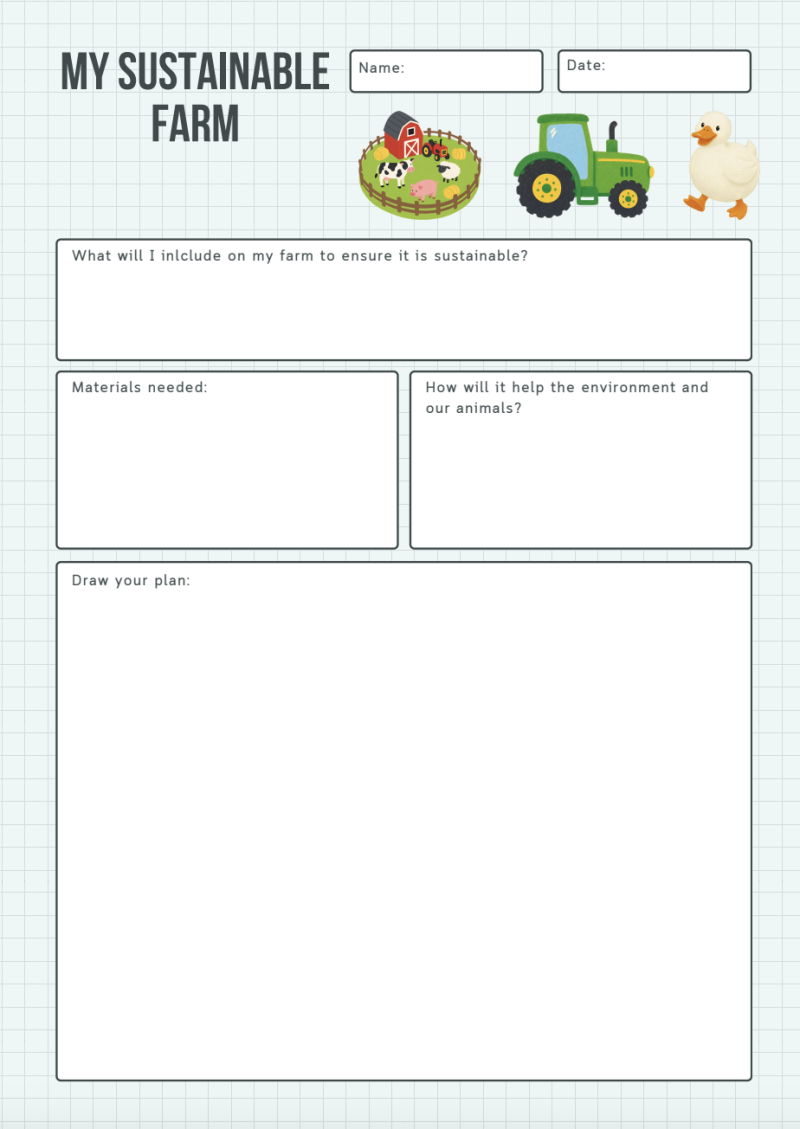
Physical Resource 4: Sustainable Farm Planning Sheet
Purpose: Supports Learning Experience 2 by scaffolding students’ planning before constructing their 3D farm.
Annotation:
The Sustainable Farm Planning Sheet provides students with a scaffold to develop and communicate their ideas before constructing their 3D farm model. Students can draw an aerial-style plan and label features that demonstrate environmental care.. The planning process encourages students to think carefully about how each feature contributes to sustainability before selecting materials and beginning construction. The scaffold also provides teachers with evidence of students’ thinking and can be used to assess how students are applying their understanding of environmental care in their own ways.
Each resource supports the learning experiences by providing authentic information, visual evidence and opportunities for students to investigate, communicate and apply their understanding of environmental care and sustainability.
540 Words
Create Your Own Website With Webador